
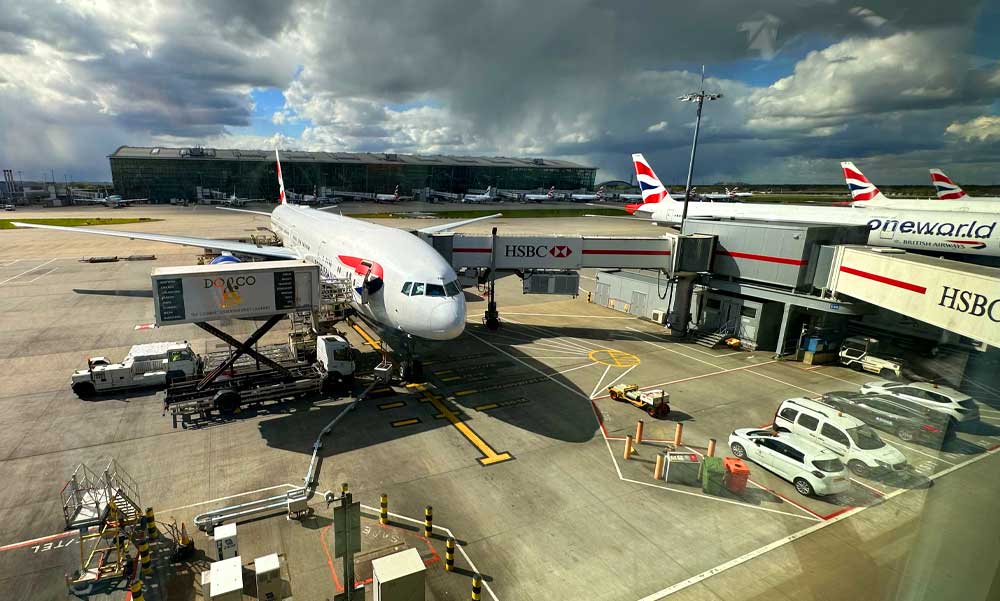
For many travelers, the journey to Europe begins at London Heathrow Airport. Located just 24 kilometers west of central London, Heathrow is not only the United Kingdom’s main international airport, but also Europe’s busiest and most important aviation hub. By passenger numbers, Heathrow consistently ranks first in Europe and among the top airports globally, handling close to 85 million passengers per year.
This sheer scale makes Heathrow a true gateway to Europe. The airport connects the continent with North America, Asia, the Middle East, Africa, and beyond. Around 90 airlines operate at Heathrow, serving more than 230 destinations worldwide. Its transatlantic network is especially strong, making it the primary entry point to Europe for travelers arriving from the United States and Canada.
From Farmland to International Airport
Heathrow’s story began shortly after World War II. The airport officially opened for commercial flights in 1946, on what was once a quiet area of farmland and small villages. In its early days, Heathrow was a modest operation, with temporary buildings and basic facilities, yet it quickly became clear that London needed a major international airport to support its global role.
The first permanent terminal opened in 1955, originally known as the Europa Building. This marked the beginning of Heathrow’s transformation into a modern airport. Over the following decades, the site expanded rapidly, reflecting the explosive growth of air travel in the second half of the 20th century.
Expansion and Modern Heathrow
New terminals were added as passenger numbers grew. Terminal 3 opened in the 1960s, Terminal 4 followed in the 1980s, and the landmark Terminal 5 opened in 2008, becoming one of the most advanced airport terminals in the world. Each expansion pushed Heathrow closer to its current form: a dense, highly efficient airport operating at near-maximum capacity.
Today, Heathrow consists of multiple terminals, extensive rail and underground connections, and a wide range of services, from luxury shopping to business lounges. Despite its size, the airport faces constant pressure to modernize and expand further, with ongoing debates around capacity and sustainability.
Why Heathrow Matters
What sets Heathrow apart is not just its size, but its role. It is a critical link in global travel, business, and tourism, handling millions of connecting passengers every year. For many visitors, Heathrow is their first impression of both London and Europe.
More than an airport, Heathrow is a symbol of global movement — a place where continents meet, cultures intersect, and journeys begin. For travelers heading to or from Europe, few airports are as significant, or as iconic, as London Heathrow.
Cover photo: London Heathrow Airport – Photo by MyBestTravelExpert.com
